Paintless Dent Repair vs Traditional Bodywork
When a vehicle gets a dent, there are two main ways to repair it: Paintless Dent Repair (PDR) and traditional bodywork. While both approaches have their place in the industry, they are designed for different kinds of repairs and different types of results. Understanding the differences between the two helps you communicate value to customers and decide which skills to learn as part of your auto reconditioning career. PDR has become one of the most popular and profitable services in the reconditioning world because it provides a fast, skilled, and paint-preserving solution for dents and dings. Traditional bodywork, on the other hand, is used when a panel is too damaged to be reshaped and requires repainting or refinishing. The right method depends on the damage and the outcome the customer wants.
What Paintless Dent Repair Is
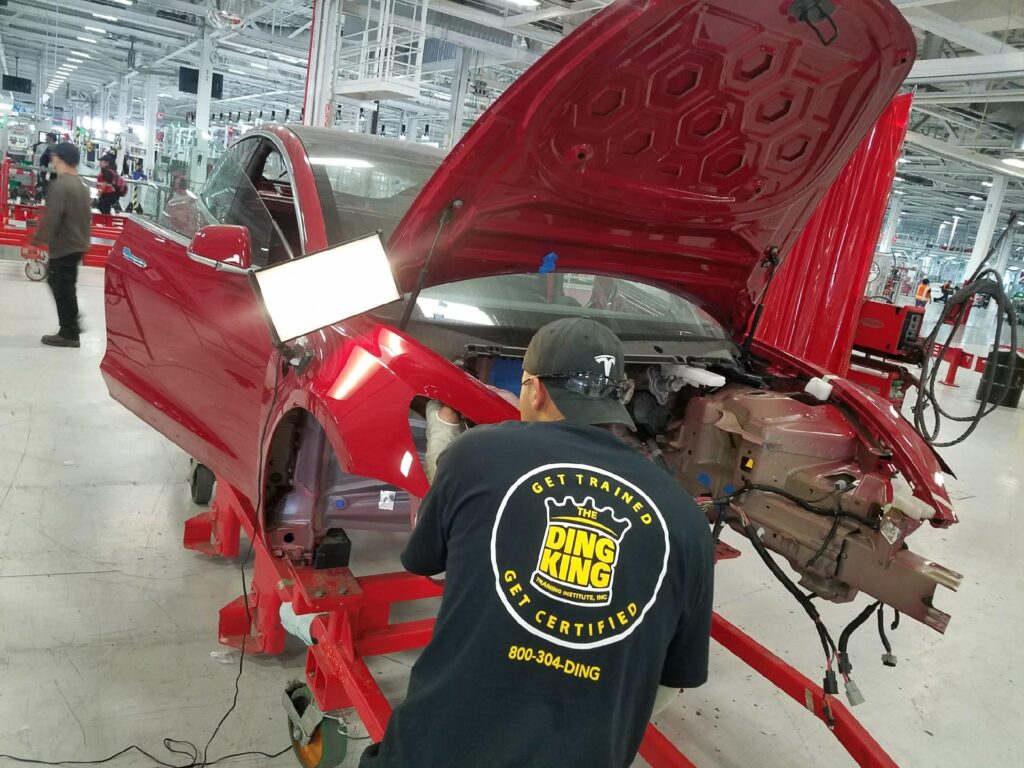
Paintless Dent Repair involves reshaping metal from behind the panel using specialized tools and controlled pressure. The technician slowly massages the metal back into its original form. No sanding, filling, or repainting is required, and the factory paint remains intact. The result is a clean, seamless repair that leaves no trace of the damage.
What Traditional Bodywork Is
Traditional bodywork involves sanding, filling, priming, and repainting the damaged area. This creates a new finish rather than restoring the original. It is effective for larger or sharp dents where the metal is stretched or where paint has already cracked. The process requires more materials, more time, and often more cost.
Side-by-Side Comparison
| Feature | Paintless Dent Repair (PDR) | Traditional Bodywork |
| Paint Preservation | Keeps original paint | Requires repainting |
| Repair Time | Often same-day | Several days to weeks |
| Cost | Lower due to less labor and materials | Higher due to products and paintwork |
| Best For | Small to medium dents, hail damage, door dings | Deep dents, sharp creases, paint damage |
| Result | Factory finish remains untouched | Surface finish depends on paint quality and match |
The less work done to disturb the vehicle’s original finish, the better the long-term value.
Why PDR Is One of the Most Valuable Skills You Can Learn
PDR is considered a high-skill, high-value craft within auto reconditioning because it requires precision, patience, and technique. But once learned, the earning potential is strong. Customers love PDR because it maintains the original paint. Dealerships love it because it speeds up inventory readiness. Insurance companies value it for hail damage repairs because it avoids costly repainting.
“Customers will always choose repair over replacement when the result looks factory-fresh.”
When Traditional Bodywork Makes More Sense
There are situations where PDR is not the best solution. If the metal is severely stretched, the paint has cracked, or the damage affects a structural area, traditional bodywork is necessary. The key is learning to evaluate damage accurately so you always choose the method that delivers the best final result.
Key Takeaways
PDR preserves the vehicle’s original finish, making it highly desirable for customers and dealerships.
Traditional bodywork is necessary for severe or paint-damaged dents.
PDR is faster, more affordable, and higher-margin for technicians.
Learning PDR first can accelerate your earning potential and customer base.
FAQs
Q: Do I need experience to learn PDR?
No. PDR is a taught skill. It develops through guided practice and repetition.
Q: How long does it take to become confident with PDR?
Most students see progress in their first week of hands-on training, with continued improvement over time.
Q: Will learning PDR allow me to work with dealerships?
Yes. PDR is one of the most commonly requested dealership services.
Ready to Take the Next Step?
If PDR interests you, the best way to move forward is to talk through your goals and see what learning path fits your timeline. There’s no commitment — just clarity.